Pages

Friday, 15 July 2011

The Road to Nationals - The Top Tier

In this article I intend to discuss my predicted top tier decks for the Standard format with M12 legal as of today. I have provided rough lists for each deck, based on results prior to M12 as well as expected inclusions. I will continue to investigate the format over the next week as I move on to investigate the current fringe decks threatening to break into the top tier. So let’s get started!

The Top Tier

4Valakut, the Molten Pinnacle
3Terramorphic Expanse
3Evolving Wilds
6Forest
12Mountain
4Primeval Titan
4Overgrown Battlement
4Solemn Simulacrum
2Urabrask the Hidden
1Oracle of Mul Daya
1Avenger of Zendikar
4Explore
4Rampant Growth
3Green Sun's Zenith
2Lightning Bolt
2Dismember
1Harrow

At Pro Tour Paris earlier this year, Valakut was destined to dominate. Or so it seemed, until Sword of Feast and Famine proved to be too much for the Molten Pinnacle to handle. Though Valakut has seen a fair amount of success during the reign of Caw-Blade, it now has the opportunity to jump back into the spotlight. Four key cards have been released since Valakut was last truly considered to be a competitor. New Phyrexia brought us the alternative to Summoning Trap in Green Sun’s Zenith, acting as a far more reliable Primeval Titan 5-8 as necessary, whilst Urabrask the Hidden allows swift one turn kills with Primeval Titan. With these additions boosting the deck’s ability to kill, M12 has brought tools to improve reliability in the form of Rampant Growth and Solemn Simulacrum.

Valakut is undoubtedly at its prime right now, and has a solid assortment of sideboard options available to it. Pyroclasm and Slagstorm are very powerful sweepers at the moment in Standard, with Act of Aggression and Combust providing solid outs to specific threats such as Splinter Twin. As for creatures, green provides a wonderful selection of useful beasts to work with. Thrun is a powerful option with control currently depending heavily on their spot removal, and similarly Gaea’s Revenge is proving to be an efficient win condition now that Sword of Feast and Famine and Baneslayer Angel are a rare sight. Obstinate Baloth rounds up the sideboard options, and will likely be a necessity with the inevitable rise of red aggro this format.

4 Scalding Tarn
2Misty Rainforest
7Island
7Mountain
4Tectonic Edge
4Deceiver Exarch
3Spellskite
1Wurmcoil Engine
1Treasure Mage
4Splinter Twin
1Mindslaver
4Preordain
4Ponder
3Gitaxian Probe
3Into the Roil
4Mana Leak
2Dispel
2Mental Misstep

The Deceiver Exarch + Splinter Twin combo is so powerful in Standard that it made a strong impact on the format during the reign of Caw-Blade, and even spawned a hybrid deck with Caw-Blade itself in its final weeks. Starting with that in mind, it isn’t difficult to see Splinter Twin as the benchmark by which all Standard decks for the remainder of the season will be judged. With the reprint of Ponder, Splinter Twin gains even greater reliability, threatening Valakut for the position of best combo, if not best deck, in the format!

Splinter Twin amazingly has main deck space to work with when planning for specific metagames. In the build above, I opted to include the flexible and powerful Treasure Mage package introduced by Patrick Chapin at Pro Tour Paris, only to be forgotten in the Stoneforge driven era. Mindslaver is a brutal win condition against combo right now, particularly with the widespread use of Spellskite. Wurmcoil Engine gives the deck the time it desperately needs against aggro, whilst providing a backup beatstick to threaten opponents who are dead set on stopping the your combo.

In terms of a sideboard, the generic options available are very solid in both blue and red. Combust answers opposing Exarchs, Pyroclasm slaughters aggro, Spreading Seas can be used to back up the Tectonic Edges and there’s always Dismember for everything, obviously. The sideboard is very open to tinker with, allowing for added win conditions such as Titans, or even complete transformations into control or unexpected combo’s such as Shape Anew. Transformation into a wildly different combo proved relatively successful for Pyromancer’s Ascension decks last summer when they sided into Polymorph, and with no Mind Sculptor the idea of Shape Anew into Blightsteel Colossus is quite tempting. The card that will definitely see an increased presence in sideboards, and possibly even main decked, is Mental Misstep. Discard and red present plenty of one cost spells that you would definitely want to counter, and so just like Spell Snare before it I certainly expect Mental Misstep to see play this summer, and Splinter Twin looks to be the best home for it (at least intially).

4Creeping Tar Pit
4Darkslick Shores
4Drowned Catacomb
4Tectonic Edge
5Island
5Swamp
1Consecrated Sphinx
1Grave Titan
1Wurmcoil Engine
3Jace Beleren
1Liliana Vess
4Mana Leak
4Preordain
3Inquisition of Kozilek
1Duress
1Despise
3Go for the Throat
2Dismember
2Into the Roil
4Spreading Seas
1Stoic Rebuttal
1Black Sun's Zenith
1Jace's Ingenuity

After total domination at Worlds last year, UB Control vanished completely at the dawn of Caw-Blade. At GP Singapore the control legend Shouta Yasooka successfully top 8’d with a control list utilizing Torpor Orb to beat Stoneforge Mystic, but the shell of the deck was very traditional. As soon as the bans came into force, UB Control leapt to the top of the Magic Online Daily events, proving the popularity of blue based control above anything else. With a selection of the most powerful win conditions to work with, UB is capable of reliably disrupting combo and controlling the board with efficient removal.

With M12, UB Control faces the threat of increased reliability from combo and pace from red. Without the flexibility of white’s red hate, UB will have to carefully tailor its anti-aggro package. Flashfreeze is an obvious inclusion, hitting almost every key spell in the format. Batterskull and Disfigure present some of the most effective answers to aggro, but the inclusion of alternative kill such as Doom Blade may become increasingly relevant with the rise of Tempered Steel decks. Further discard with Duress backed by Surgical Extraction could prove to be an effective package in combating the inevitable mirror, but diversity in win conditions between the main and side is definitely necessary. Calcite Snapper and Vampire Nighthawk have both seen varied success in the past out of UB Control sideboards, both in holding off aggro and tactically providing the opportunity to transform into a more tempo-oriented deck. Unsurprisingly, control will have to handle several main deck slots and the majority of the sideboard based on the evolution of the format. Either way, expect Flashfreeze and Mental Misstep to become a regular sight.

4Blackcleave Cliffs
4Dragonskull Summit
4Lavaclaw Reaches
4Marsh Flats
7Swamp
4Bloodghast
4Gatekeeper of Malakir
4Kalastria Highborn
4Pulse Tracker
4Vampire Lacerator
3Viscera Seer
4Dismember
3Go for the Throat
4Lightning Bolt
3Staggershock

Even prior to the July 1st Ban List update, Vampires were making a name for themselves. Even the mighty Caw-Blade struggled to stand up to the raw aggression of Vampires, with the deck claiming the win at both the Denver and Indianapolis SCG Opens in June. With a powerful set of removal spells and burn to supplement the weenie rush, Vampires utilize Bloodghast and Highborn to continue to build momentum in the face of removal. Though little is gained by the deck in M12, the fall of Caw-Blade has resulted in a sharp drop in the presence of Sword of Feast and Famine, making Vampires a better choice than ever.

Though it has to compete with many other fast decks right now, black provides Vampires with a couple of major advantages in sideboarding. Discard spells like Duress allow Vampires to handle combo and control, and a wide variety of spot removal spells for aggro of all flavours. Act of Aggression and Dark Tutelage are solid options to maintain control of the game as it progresses, and the ability to drop an early Demon of Death’s Gate could yet again allow the deck to race combo decks like Valakut whilst they sit back playing solitaire.

4Arid Mesa
4Scalding Tarn
4Teetering Peaks
10Mountain
4Goblin Guide
4Grim Lavamancer
4Furnace Scamp
4Stormblood Berserker
4Lightning Bolt
4Burst Lightning
4Incinerate
4Searing Blaze
2Staggershock
4Shrine of Burning Rage

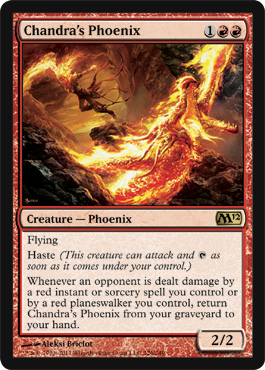
With M12 it should come as no surprise that Red is firmly back in the top tier. Following the surge of powerful burn spells in Zendikar, the addition of Shrine and Lavamancer helps the deck get there by providing an inevitability. This rough list follows a more traditional RDW route, but be prepared for a wide variety of powerful threats from players tapping Mountains. Koth is still an incredibly powerful Planeswalker (arguably the most powerful since the departure of Jace, the Mind Sculptor) but really requires 23-25 lands to be played, eating into some of the space occupied by burn at present. Chandra’s Phoenix is another powerful beast that would likely be best suited to a more reliable mana base, resulting in a list similar to Katsuhiro Mori’s winning list at Japan Nationals last year.

Red also has a wealth of powerful sideboard cards at the moment. Dismember is a vital tool for answering previously unanswerable threats such as Kor Firewalker. Combust is the perfect answer for Deceiver Exarch in that it cannot be redirected by Spellskite, and Act of Aggression adds a new dimension to the traditional use of Threaten in being able to seize control at instant speed, preventing Primeval Titan wins and more. In hating control decks, red has access to Manic Vandal to disrupt the various Spellskites and Batterskulls, whilst Manabarbs thrives in a format lacking in answers to enchantments aside from Oblivion Ring.

4Glacial Fortress
4Inkmoth Nexus
6Plains
4Seachrome Coast
4Memnite
4Signal Pest
4Spellskite
4Steel Overseer
4Vault Skirge
4Dispatch
4Glint Hawk Idol
3Mox Opal
4Origin Spellbomb
3Preordain
4Tempered Steel

Following Pro Tour Nagoya it should come as no real surprise that Tempered Steel aggro would make its way over to Standard at some stage, but the sheer popularity of the deck recently on Magic Online certainly does surprise! The last time a deck made such a dramatic transfer was during the Lorwyn Block PTQ season when Kithkin first started to use Windbrisk Heights to hideaway everything from Thistledown Liege to Mirrorweave. Following dramatic success in Block, Standard saw a sudden surge in popularity for the deck, eventually resulting in the major success of such decks as BW Tokens.

Tempered Steel plays very much like an Affinity deck, being able to drop very cheap creatures that result in a critical mass of damage a couple of turns down the line. Interestingly, Inkmoth Nexus presents a truly terrifying alternate dimension to the deck, in that it can threaten to kill even if you manage to bring your life total under control. It is worth noting here that the ability to include Spellskites in the main prevents the deck from falling victim to combo when they fail to interact. Add to that the fact that Dispatch, in this deck, is scarily superior to Swords to Plowshares, and we have a fearsome deck to be reckoned with.

As with any deck in Standard, Dismember is always a solid sideboard option for any threats to be feared, but white also provides plenty of solution cards such as Celestial Purge and Revoke Existence. Phyrexian Revoker and Hex Parasite provide strong tools to wield against the still Planeswalker dependent control decks, and Etched Champion serves to imitate Paladin en-Vec.

To Be Continued...

I'll follow up shortly with the decks competing to enter the top tier. Any suggestions or recommendations for the article are welcome, and feedback will be much appreciated!

Wednesday, 13 July 2011

Exceeding Expectations?! Xyz Shōkan!

With the conclusion of Yu-Gi-Oh! 5D’s, yet another era came to a close for the game. With their introduction in Duelist Genesis, Synchro monsters quickly became a force to be reckoned with. The final duels of the 5D’s series led Synchro monsters to their peak; an incredible engine in T.G. Hyper Librarian and a powerful win condition in Shooting Quasar Dragon. Synchro monsters have been the dominant force in the Japanese metagame, and clearly the most popular strategy in the TCG. 

As Yu-Gi-Oh! enters its fourth era, a new type of monster intends to build upon the success seen by Synchro monsters. Tuners were made with a single intent; to be low-level, underwhelming monsters with Synchro assisting abilities that can be splashed into any deck. They act as the “cost” you are required to pay in terms of space when deck building, in order to grant access to such a wealth of utility and power. However, Konami has instead designed a new breed of monster that can be splashed into the Extra deck of any deck playing monsters! 

Xyz monsters are unique in their nature. The material used in summoning remains trapped under the card until either it leaves the field, or the materials are detached by an effect. This is clear evidence of Konami wanting to avoid the speed Synchro tricks we’ve seen most recently from decks using Plant engines. The truly unique aspect, however, is the fact that Xyz have no Levels, and instead have Ranks. This again acts to prevent any connection with Synchro monsters, whilst also granting immunity to many of the threats faced by Synchro monsters. 

          
When introduced, Synchro monsters made an impact with such powerful monsters as Stardust Dragon, Colossal Fighter and Goyo Guardian. Can the introduction of Xyz monsters match up to the expectation set by their predecessors? In this article I intend to give an overview of the Xyz monsters being introduced both in this month’s Starter Deck 2011 and in the August set, Generation Force.


Starter Deck: Dawn of the Xyz
Following in the footsteps of Stardust Dragon, Utopia clearly shows us how far the game has come from the vanilla wielding heroes of GX and the original series! Utopia’s epic Gundam-esque design is supported by aggressive stats and the ability to play defender for a couple of turns. This card clearly embodies the idea behind Xyz monsters, a solid win condition worth protecting, with a drawback that discourages reckless use of his ability. As a Rank 4, Utopia also has the benefit of being incredibly simple to summon in a wide array of decks, be it through use of Gadgets, Gravekeeper’s Spy, Reborn Tengu or recruiters of all flavours. Utopia will see play, and lots of it.
Our first Rank 3 Xyz follows in Utopia’s footsteps by wielding aggressive stats. Grenosaurus’ ability allows you to push for damage with ease, preventing defenders like Dandylion, Treeborn Frog and Reborn Tengu from giving the opponent time to recover. Unlike Utopia however, Grenosaurus is of a Rank that is harder to form, requiring genuine monsters rather than tricks in the majority of decks. However, being able to summon a 2000 atk beatstick when in a pinch is always worth taking into consideration for decks running level 3 monsters that have space in their Xyz deck. Grenosaurus will, however, be swiftly outclassed in Generation Force.
This monster presents us with something quite different to consider. Unlike the win condition that is Utopia and the beatstick that is Grenosaurus, Gantetsu is very much a supporter monster. Gantetsu has sturdy defensive stats, providing a boost more akin to a field spell than a monster. However, the fact Gantetsu protects himself from destruction twice is surprisingly relevant, making him an incredibly resilient defender. It is likely that Gantetsu will be the most played Xyz from the starter deck as he already has a home in Agents, making Venus’ ability to swarm the field with Mystic Shine Balls far more powerful than ever.


Generation Force
The first TCG exclusive Xyz is quite a monster. With 2600 atk it’ll beat down over most monsters, but Adreus’ ability is the show stealer. Being able to destroy any face up card is just incredible, answering Necrovalley, Gateway of the Six and any threatening monster standing in its way. At Rank 5, Adreus is a little optimistic at the moment, but in October Structure Deck - Gates of the Underworld will pull the Dark World theme back into the spotlight. Summoning Goldd and Silva with ease, Dark World will be a welcome home for Adreus this Winter.


Sharing Adreus’ basic stats, Tiras plays a very different role to its demonic alternate. Whilst Adreus lands and destroys threats there and then, Tiras requires a well timed summoning to punish the opponent. Though Dimensional Prison and Book of Moon are dangerous threats, Tiras can force through many traditional defences and should it battle, any single card on the field can be destroyed. Destroying set cards following a combat situation seems relatively awkward, but remember that Tiras can act as a wall for two turns quite happily, before leaving you with a powerful beatstick. It is also worth remembering that Honest works wonders with Tiras, should a light based deck be able to support it adequately in future.
The inclusion of this card in Generation Force shows Konami’s determination to drive people away from Synchro’s and towards their latest creation. With 1900 atk, Roach leaves a lot to be desired when compared to Utopia at the same rank, but Roach is all about the effect. Being able to negate the special summon of anything from Hyper Librarian to Chaos Sorcerer, Roach threatens the vast majority of todays top decks. With an ability that demands respect, Roach is already seeing widespread play in Japan, and is played heavily alongside Utopia in the Gadget + Ultimate Offering strategy that is seeing an increase in popularity. Expect people to find means of splashing Xyz into their extra decks just to deal with these Roaches.
This Rank 4 machine enters play with stats closer to Utopia, with an intriguing ability to work with. The ability to flip-flop your own monsters is a curious effect, and anyone who ran Tsukuyomi will remember how rewarding it can be to rest your effects. Ryko seems to be the prime target right now, but with Gravekeeper’s keeping their levels primarily at 4, Zenmaister could prove to be an attrition engine with Spy, should the peculiar situation arise. Zenmaister, for his effect, appears to be quite underwhelming upon release, but could well become a powerful engine with further additions to the Wind-Up theme. As a machine type though, expect him to be splashed heavily in Gadget Offering decks for ease of OTK via Limiter Removal.
Let’s get the underwhelming Rank 3 out of the way, shall we? Aero Shark has very little going for it, with relatively disappointing stats and a painfully nerfed ability from its anime incarnation, I sincerely doubt Aero Shark will see play.


Terror-Byte has the honour of being the first Xyz in the TCG to require more than 2 materials to form it. Though this makes it more challenging to summon, the ability to take control of an opponent’s monster three turns in a row is certainly powerful. If Terror-Byte were Rank 4, Gadgets would find a use for this monster, but at Rank 3 it will likely struggle to see play. However, with the TCG exclusive access to Tour Guide from the Underworld it is worth keeping an eye on a card with such a powerful effect.


Leviair was the most powerful Xyz monster in Generation Force when the set released in Japan, and though Steelswarm Roach poses a strong challenge it is very likely to be the star of the TCG release as well. Tour Guide from the Underworld will be key to this card’s success in the TCG, working independently with a Sangan as well as finding homes in decks such as Dark World in the near future. Summoning the materials is easy enough, but what are the benefits? Likely the best use for the card will be in combination with Genex Ally Birdman, Plaguespreader Zombie and Spore. These Tuners are incredibly powerful, and can see exceptional abuse through Leviair. Infernity may well prove to be the best deck to make full use of this Xyz, though time alone will tell. Levaiel is a very exciting card, and will only get better with time.
And so we end our look at the initial wave of Xyz monsters with the cover card of Generation Force. Leviathan Dragon initially received a lukewarm response from players, essentially being a vanilla 2500 atk monster that can, if it survives the turn, jump to 3000 atk at the cost of being able to attack for game. Time has certainly worked in the favour of this card, as making a powerful beatstick out of the blue is still strong! Leviathan Dragon can beat over a wide variety of powerful, widely played monsters on the first turn, whilst being able to trade with Stardust Dragon and Legendary Six Samurai Shi En. Should Leviathan Dragon survive a turn, very little will be able to stand in its way. 


The initial wave of Xyz monsters were treated very warily upon release in Japan, but time has revealed that they compare very strongly to the initial wave of Synchro monsters. The difference is application, as Synchro’s were obvious powerhouse monsters, Xyz are far more subtle and controlling. Xyz monsters are here to stay, and it will be vital to learn to wield and answer their powerful abilities in the near future.

Tuesday Night Magic - 05.07.11

As Jace, the Mind Sculptor and Stoneforge Mystic left the format peacefully at the end of last week, I was driven to try my hand at control in the new format. The lack of Oblivion Ring held me back from playing UW Control, despite the draw of Venser, and instead I helped a friend build up the UW list as an experiment. Though the desire to experiment with interesting decks was strong, I naturally crumbled and fell back into the clutches of UB Control. The lack of Mind Sculptors hurts the deck considerably, but without swords seeing heavy play the ability to draw out the game with spot removal before dropping overpowering bombs was too tempting to resist. The list I went with can be seen below, though do note that my lack of Surgical Extractions is the only reason for their absence! Space should definitely be made for them in the sideboard.
UB Control Main Deck
UB Control Side Deck

Round 1 - UW Venser - 1-0-1
A thoroughly interesting match, with bombs causing swings back and forth throughout each game. Blade Splicer proved to be particularly powerful, but lucky timing on my part let me keep the board under control with Black Sun Zenith whilst my discard kept his utility at a minimum. As game 1 took a relatively long time to tie up, game 2 set me the aim of drawing for the win. Any hope of a fast win vanished as he began to establish board control, but spot removal and well timed discard kept him from finding a win condition, despite having a Venser ready to fire off his ultimate. 

Round 2 - Myr Twin - 2-0-0
This deck certainly caught me off guard by combining arguably the most powerful and most forgotten combos in standard into a single disruptive deck. In game 1 I manage to gain control fairly effectively and push for a win. Game 2 draws out for far longer as I struggle to find win conditions. I push through a couple of Memoricides to remove his Splinter Twins and Red Sun Zeniths (!), but seeing he still has Lightning Bolts and was still beating face with Myr, the fear set in. A lucky top deck of a Consecrated Sphinx allowed me to tap out knowing he has to top deck one of his three remaining Lightning Bolts to win before I can start to overcome him with draw. Thankfully he doesn’t draw the Bolt for several turns whilst I carefully pick off targets on board and push with a Wurmcoil Engine pulling me back into safety. If this match taught me anything it is to be very careful not to miss timing with Consecrated Sphinx. Though I won in the end, I still missed 2-3 triggers with the Sphinx throughout both games by letting my attention be trapped by the cards in my hand whilst the opponent starts off their turn.

Round 3 - MBC - 2-0-0
This round gave me the excellent opportunity to see the new, and highly promising, Mono Black Control deck in action. Though a few elements were different to those gaining popularity online, the shell of the deck was very much the same. His discard and removal were arguably stronger than mine, and if he could land a Lashwrithe the game would be over very quickly, much like how Korlash once ended games alone. Both games were good up to a point, but unfortunately he stumbled in both games in drawing land or irrelevant answers whilst I managed to push through with Creeping Tar Pits.

Round 4 - UB Control - 1-2-0
Unsurprisingly it was a mirror match that ended my winning streak. Each game was a battle of attrition, with Planeswalkers and discard proving vital in seeking the opportunity to land and protect a threat. Tectonic Edge played a violently disruptive role in each and every game, and this match alone just reminded me of how attempting a deck running more than two colours is simply impossible right now. As the last game drew to time, I was fighting off a bouncing Batterskull with my Karn Liberated, resisting fatal damage for several turns, before mistakenly thinking I had a turn to pump him up again whilst blocking with a Creeping Tar Pit. In my haste I missed his remaining Tectonic Edge, and handed over the game on turn 3 of time. I was now painfully aware of how many misplays I was making, my lack of experience proving very disheartening when it comes to control mirrors in which I should be playing better.

Round 5 - UW Venser Fish - 1-2-0
The final round for the night proved very unexpected. Despite having spoken to the player about the deck earlier in the evening, the sheer ferocity and utility of an equipment engine post-Stoneforge certainly caught me off guard. Puresteel Paladin is an absolute monster, especially whilst people are still ignoring the fact that Swords of X and Y are all extremely powerful on their own, and that Squadron Hawk is still pure advantage. Painfully we both pass each other games based on mana screw, before playing a real game in game 3. I attempt to control the board with a Precursor Golem before he fights back with a Phyrexian Metamorph. Dismayed by the incredible clone, I drop a Wurmcoil Engine and ready to defend when his equipment becomes active. A second Metamorph becomes a Wurmcoil Engine, and via Puresteel Paladin his Mortarpod and Basilisk Collar combo allows him to slaughter my defenders.

Conclusion - 3-2
After a strong start, I disappointingly end with a very average standing. Having expected a very RDW and Valakut focused meta, my lack of good options to board against control hurt, but nowhere near as much as my own misplays did. Once M12 arrives, practice will be key if I intend to fight the good fight at Nationals again this year, and that includes practicing the dreaded M12/M12/M12 draft.
UB Control is still a powerful deck, but this event reminded me of the importance of patience and focus in playing the deck. It is an incredibly demanding beast to handle, and certainly punishes misplays horrifically. Despite playing the proactive disruption package of discard spells, UB Control still plays far too carefully and reactively to impact a mixed field. With the popularity of UB Control and the imminent rise in RDW, it seems very likely that Mental Misstep will make its first major debut into Standard, taking up a role very much like the splashes of Spell Snare back in Kamigawa/Ravnica Standard to control tempo by stopping Scab-Clan Maulers, Umezawa’s Jitte, Castigate and, most importantly, Signets.
On a side note, the UW list I helped a friend build before the event ended up winning, beating my round 4 opponent in the finals. Having admittedly made many misplays throughout the day, it seems that UW Control is the more forgiving deck to work with, and is likely to become even more so with the return of Oblivion Ring. It is highly likely that I will end up focusing on UW Control simply due to its more proactive, tap-out nature. Hopefully M12 stirs the game up as required, because banning a couple of cards certainly hasn’t made the format as interesting as promised.

Saturday, 2 July 2011

Road to Nationals - M12 Impact

In the run up to the UK Magic National Championship this year I will be discussing the Standard format as it evolves globally and locally. Whilst the banning of Jace, the Mind Sculptor and Stoneforge Mystic has blown the format wide open, it isn't until the arrival of this year's Core Set, Magic 2012, that we can fully begin to gauge what direction the format might take. In this post I would like to discuss the cards revealed thus far that will most impact Standard for Nationals. I emphasise, this is not a review and is not looking forward to rotation or anything like that. The purpose of the "Road to Nationals" posts to build and prepare for the single most important event in the nation.

Stating the Obvious
Only one card at the beginning of the spoiler season had an immediate home, and that was Rampant Growth. With Valakut already showing a dominant presence in new Standard, the return of Rampant Growth will be receive a warm welcome from the many players seizing their opportunity to rise above the competition now that the Stoneforge fuelled clock of Caw-Blade is a fading nightmare.

The other Primeval Titan based strategy to benefit from this return is Eldrazi, with the lack of Jace around to disrupt the deck in its setup phase. Though the Splinter Twin combo poses a tremendous threat to "do nothing" strategies like Valakut and Eldrazi, the sheer amount of easy hate for the combo allows the big green strategies to flourish.

White Blight
It will come as no surprise to those who know me that the thought of losing to a weenie deck of any kind is a thoroughly depressing experience for me. Thankfully, successful rush strategies are fairly rare, with success stories rising infrequently of crazy Ezuri combo's and perfectly curving into a Ball Lightning with Teetering Peaks. White, however, hasn't truly seen a successful weenie rush strategy since Kithkin, back at the start of Lorwyn standard, and BW Tokens at the end of the same format. After the disappointment of the Quest for the Holy Relic combo builds, white has earned a few aggressively priced tools to work with.

Grand Abolisher is the latest in the series of white-based bears with anti-control abilities tacked on. Whilst many of these bears have seen a good amount of play in the past, this particular beast is most reminiscent of Gaddock Teeg in his prime. Remember when Kithkin curved out perfectly with Goldmeadow Stalwart into Wizened Cenn, whilst you comfortably wait with Cryptic Command and Wrath of God sitting in hand. Then they summon Gaddock Teeg whilst you're sat waiting with Vivid lands. Teeg locked players out of their solid and reliable strategies, and most importantly out of their comfort zones. Grand Abolisher promises to do the same this format.

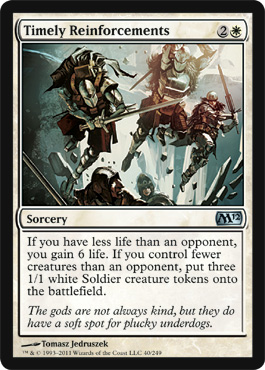
Fans of SCG's "The Magic Show" will undoubtedly be able to recall Evan Erwin's memorable response to the reveal of Spectral Procession. His words "Three. Dudes. Seriously." can yet again be put into action by taking a look at Timely Reinforcements. Yet again we have a 3cc Sorcery that makes tokens, but only if your opponent is ahead. While these tokens don't fly, Timely Reinforcements shows strong potential as a counter-strike card for a deck dedicating space to Honor of the Pure and Student of Warfare. Spot removal will be rampant in new Standard, but so will walls. Wall of Omens and Overgrown Battlements will be widely played, making the curve of Honor of the Pure > Timely Reinforcements > Ajani Goldmane and swing for 9 perfecly do-able. Time will tell if it is worth it, and if a splash into black or red can make better use of the dead first turn.

The final aggressively designed white card in fact evokes the spirit of a classically played control win condition. Angelic Destiny is a difficult card to crack, as it is quite difficult to compare reasonably to anything in the past. The boon for enchanting a creature is certainly worthwhile for the cost, but the initial fear is resolving the enchantment safely. Aura's have traditionally seen minimal play due to the ability to claim a 2-for-1 in killing the target and forcing the enchantment to fizzle. The fear of losing both creature and aura after resolution, however, is non-existent thanks to the fact that this card jumps back into the hand when the creature dies. This reminds me of how Griffin Guide allowed for a continual and determined push from aggro decks in Time Spiral Block, but as the Guide never really graduated into Standard play it's difficult to gauge whether this card stands a chance. If it does, it will be on the shoulders of Grand Abolisher and his game warping effect.

Blood Red
Though white appear to have the potential to flourish following M12, Red decks are already quite a common sight. Red provides a difficult clock to beat, punishing decks like Valakut for taking them too lightly. Of the cards showing potential in M12, red definitely dominates in numbers. Incinerate returns in M12, and will see play immediately, however the big reprint is that of Grim Lavamancer. While most will likely remember Lavamancer for his punishing finisher potential in Zoo decks of Extended's past, his most recent action has actually been in Legacy blue-based control decks splashing red just for him! The lack of need to swing past walls is just as strong as the ability to pick off creatures of toughness 2 or less every turn, and I expect Grim Lavamancer will find a home in a wide variety of decks.


Red decks will also be presented with an interesting choice with M12. Throughout Scars Block we saw a gradual push towards playable Goblins, and M12 brings the catalyst for the deck in the form of Goblin Grenade. With the sheer number of strong goblins we have to work with, it shouldn't be hard to form an incredibly fast clock.


Chandra's Phoenix, however, provides red with an option somewhere between Vengevine and Hell's Thunder. That comparison alone shows that the Phoenix is in good company, and will undoubtedly see play in Red Deck Wins during the Nationals season. I myself ran RDW last year due to the sheer speed and reliability of the Unearth mechanic, and this little bird is already tempting me to tap Mountains again!


Illusion or Delusion?
Despite the obvious quality of Lord of the Unreal, I simply dismissed the potential of an Illusion aggro deck on the fact that a Bear and Djinn that die to Grim Lavamancer without their Lord (who ALSO dies to Lavamancer...) simply cannot hold itself together. The revelation of Phantasmal Image turned things around pretty fast however. Phantasmal Image is not only a half-price Clone in a format full of Titans, but it's a clone that is absolutely unreal entering the battlefield as Lord of the Unreal. A 3/3 Hexproofed Anthem for 2 you say? It's definitely worth keeping an eye out for these illusive wanna-be Fish.


Maintaining Control
As a control player I'm happy to see that initial results from the new format suggest that a wide variety of strategies are alive and well, even in the fact of Valakut. Spreading Seas and Tectonic Edge are clearly the tools necessary to defeat the enemy, but M12 certainly provides some powerful treats for the more patient players out there. First and very much most importantly is the card that Wizards themselves realised should not have left standard: Oblivion Ring. That's right, the most reliable, main deck-able removal card in white is back, and it couldn't have picked a better time! With Jace, the Mind Sculptor banished from the format, players have desperately sought other 'walkers to dominate with in the late game. Whilst Karn and Liliana have received an adequate amount of respect, it is Venser, the Sojourner who has seen the most significant boost in popularity. UW will now have access to Wall of Omens, Spreading Seas, Oblivion Ring, Blade Splicer, Jace Beleren, Sun Titan and undoubtedly more for Venser to blink in and out of existence before the Nationals season is over. Oblivion Ring strengthens UW strategies considerably, and is definitely where I intend to starting working on the format myself.

Every new set leads a horde of players to rant in unison that Mono Black Control is here again. With Jace gone and Sword of Feast and Famine a rare sight, MBC has already seen an increasing presence in Standard. Phyrexian Obliterator and an assortment of powerful removal and discard seems like a fair strategy, and the reprint of Distress works to reinforce MBC. Though we currently have an abundance of 1cc discard spells, we can no longer assume which versions are best for the metagame without a dominant powerhouse to target. Inquisition of Kozilek will likely remain the best discard choice, but supporting it with Distress could well prove safer than having cards end up dead in hand. This core set shockingly also sees the return of Smallpox to Standard. This will prove to be a difficult card to break without any obvious engines, but it certainly can't be ignored in a format with Vengevines and Planeswalkers retaining the advantage.


All being said, the most important card thus far in M12 for control has to be Solemn Simulacrum. Wizards has made it perfectly clear that it wants slower decks to be rewarded with powerful win conditions like Titans, and the reprint of Solemn Simulacrum reinforces this. I expect Solemn Simulacrum to see widespread play, from splashes in stable decks like Valakut to much needed acceleration in decks dedicated to our two favourite Artificers, Tezzeret and Venser. The versatility of Solemn Simulacrum is obvious, but reaches incredible new levels when used in conjunction with these two 'walkers. The interaction may even be enough to warrant a push towards a UBW list utilising the two. Unfortunately, the need for Tectonic Edge will likely make us wait for such a deck to form post-rotation instead.

Planeswalkers?
Throughout this post I have decided to stay quiet regarding our newcomer Planeswalkers, but that does not mean I do not think they're good cards. Jace, Garruk and Chandra will likely struggle to find a home during this National season. I have already made my thoughts clear regarding Jace, Memory Adept, and I will follow up soon enough with my thoughts on the other two. But as far as Standard goes for the next couple of months, expect Jace Beleren, Koth, Tezzeret, Gideon, Liliana, Karn and Venser to see play over any of our latest additions. They simply can't compare right now.

This concludes my first look at the evolution of Standard with the arrival of M12. I will follow up soon with comments on any further potential revealed by the set, as well as a few initial lists of my own and those to look out for from the events starting off the season.

Friday, 1 July 2011

Wednesday Night Yu-Gi-Oh! - 29.06.11

I was ecstatic on Monday that my T.G. Hyper Librarians had finally arrived, and as we aren't running officially yet it would provide a good couple of weeks testing for the future. Despite playing Junk Doppel for so long before now, the addition of Extreme Victory certainly makes deck building far more of a complex task than before. I dedicated my initial testing run to a build running Reborn Tengu, assuming he'd be just as good as I'm sure we're all used to by now. Surprisingly, Tengu plays horrendously in the deck, and due to (yet again!) a severe lack of time in which to test I put together a list largely reminiscent of the generic Japanese list, but favoring Solemn Warning over excessive numbers of Limit Reverse. Limit Reverse is vital in the Japanese meta due to the loss of the priority rule, making Lonefire Blossom very vulnerable to a variety of threats.  We maintain our priority rules for the foreseeable future, Warning is far more important as we have Reborn Tengu to answer.


Round 1 - Scraps - OXO
I manage to sweep game 1 without too much difficulty, as I've heard Trishula's pretty good these days. Game 2, however, took a very long time. My opponent synchro'd into 2 Scrap Dragons and 3 Scrap Twin Dragons during the game, and threatened to go again if possible. I picked off each threat, but a couple of painful errors in judgment (and, admittedly, card reading...) eventually cost me the game. In game 3 we swing back and forth, and as I'm readying an alpha strike time is called. He manages to disrupt my push with an unexpected and problematic Lava Golem (!). Thankfully I squeeze a small amount of damage through his defenses and stall out the last turn of time on higher life.

Round 2 - Fabled - OO
Having tested pretty exclusively against this deck in my most recent testing run, I shuffled up expecting him to swiftly dispose of me via turn 1 Reborn Tengu, turn 2 OTK. Whilst he managed the first turn Tengu, I was lucky enough to be able to pick apart the rest of his attempts with well-timed responses followed but a synchro rush. In game 2 he starts yet again with a Reborn Tengu and 3 set spell/traps. Obviously I manage to draw MST off the top of the deck and by sheer luck pick off his set (card name)! Back and forth pushes and stalling end with a pivotal Book of Moon on his tuner before I synchro rush for game.

Round 3 - Agents - XX
As a powerful deck with a wide variety of competitive structures to work with, I eagerly anticipated this matchup to see the performance of whatever variant he was running. I very suddenly regretted being so eager as the match reached its swift, brutal conclusion. Game 1 involved Pot of Duality into (card name) into Agent of Mystery - Earth, finally tutoring Agent of Creation - Venus, which was followed by minimal action by me allowing him to use Venus to swarm with Mystic Shine Balls and synchro into a devastating Trishula, which he rides to the win. I approach the second game optimistically thinking I just needed to start more effectively, and going first should help in that respect, but my optimism is ripped away when Valhalla lands and allows him to special summon Archlord Kristya. I stall for several turns, trying desperately to find an answer whilst he struggles to hit another monster. Ryko eventually provides me a window, but by this time he is easily able to respond to my attempts to strike back. He ends up finishing me swiftly with two copies of Master Hyperion cleaning up the board for the kill.

Round 4 - KMP - XOX
This match was a true testament to the power of the combo-enabling cards in the game right now. Each game came down to the activation of either a Giant Trunade or a Trap Stun, making Solemn Warnings feel like dead weights whilst combo loops are carried out without fail. A total lack of Effect Veiler action with him going first in games 1 and 3, I don't really need to say much as to how resilient the combo is. Chimeratech Fortress Dragon led me to my win, but my deck is far less refined and practiced in performing its combo's than KMP. And it showed clearly.

Conclusion - 2-2
Though I'm obviously fairly disappointed in what was expected to be an explosive debut for T.G. Hyper Librarian, I am now more eager than ever to unlock the potential of the card. Without Shooting Quasar Dragon at our disposal we lack the utterly dominating combo finisher a deck like this needs. A few of us at the event, by sheer coincidence, ran T.G. Halberd Cannon, and the more I see it in action the more convinced I am in its potential. But for me, this list was clearly sub-par and needs a dramatic amount of work to stand against a format of reliable powerhouses like Samurai and Agents. I'll follow up soon with my thoughts on potential routes to take.