Pages

Showing posts with label Road to Nationals. Show all posts

Tuesday, 23 August 2011

MTG GB Nationals 2011

Here we are, finally on site at GB Nationals supporting our newly opened local store and venue, The Scythe and Teacup Gamer Cafe, and ready to fight for the title of National Champion... 

/
Team Teacup?
Well that went well. Despite making use of every possible opportunity to research the developing trends in Standard, I began my testing the week before Nationals with a very undecided mindset. With minimal time to test, I settled on UB Control, but the specifics of the deck were very uncertain. I felt relatively comfortable with a list very similar to that piloted by Ali Aintrazi to seize the title at US Nationals, but I was far from certain that I’d be able to compete with the deck in the traditionally aggressive UK metagame. 
As a member of our group was attempting to grind in, a clear read of the meta could be established at the LCQ, allowing an estimation to be made as to which decks would likely see most play in the main event itself. Combo in the form of Twin as well as Red Deck Wins were quite heavily represented, as is expected of an LCQ, but those types of decks always decrease in numbers in the main event itself. UB Control however appeared to be very popular, making it a strong bet for seeing heavy play the next day. At this point I made the choice to bite the bullet and adapt my deck to work as Tezzeret Control, utilizing Torpor Orb and the ability to push with animated artifacts to fight off the expected metagame. 
And so the morning of Nationals arrives, and I ready myself for the long day that awaits. The player meeting eventually starts, and my nerves are kicking in. As I started my first match, doubt began to creep in as I faced Valakut. Despite landing an early Torpor Orb, Primeval Titan swings through as I fail to find removal, and despair starts to take over. Game 2 lasted a bit longer, as I controlled the board and slowly pushed through with Inkmoth Nexus. He readies the kill whilst sitting on five poison counters. All I need to do is find a Tezzeret to win, yet I fail to see anything beyond a land. He continues to make a mistake in his turn, failing to pull off the kill, and yet again I see nothing but land off the top of the deck. The second round pairs me against Valakut yet again, and despite solid controlling starts I manage to hit mana floods, followed by Titans and Terastadon crashing through with ease. 
Disheartened, I sat down for round 3 hoping for one of the many, many control decks I could see around me during the previous rounds. Alas, I am paired against Splinter Twin, which proceeds to beat me violently whilst Torpor Orbs prove powerless without backing of any kind. And so, on a stellar record of 0-3, I decided to drop and claim my two free drafts to hopefully recoup some of my losses from the weekend. Despite rare drafting when able(a Chandra in each draft...), my solid draft decks resulted in losses nonetheless. During the second day I decided to try my hand at the Legacy GP with a strong Team America build, but even that resulted in failure as I lose to NO RUG and draw against Enchantress and Stifle-naught. 
And so Nationals has proven a success for me in nothing more than a disheartening experience. Though I understand that I sorely lacked the time necessary to gain the experience needed to succeed, I could never have predicted that the weekend would result in a total of zero match wins across three utterly different formats. 
But if I were ever to let such losses get to me, I wouldn’t be playing Magic today. I have had my moment of painful humility and am determined to prepare for the future. With Modern developing into a deep yet innovative format, I intend to slowly work on the format and develop my skills so that I can play a better game than ever before. The Spring PTQ season will undoubtedly be played through the Modern format, and I intend to succeed this time on skill rather than luck. In order to develop I cannot work alone, and thanks to our new local venue it is time to truly begin working as team to take on the competitive scene. But more on that will follow soon enough, and thanks for reading.

Sunday, 7 August 2011

Project T - Stage 1


As Nationals approaches, I have decided to make an investigation into Standard in the hopes of finding a home for a power so gravely under-represented in the format. Project T is a quest to find a home for Tezzeret, Agent of Bolas, arguably the most powerful Planeswalker in Standard following the banning of Jace, the Mind Sculptor. The cost of wielding such a power is the relatively narrow selection of cards that must be utilized effectively in order for Tezzeret to compare favourably to Jace. The cost for such power has put many players off even attempting to get the Agent to work, but a few inquiring minds have given us a glimpse at the raw power being ignored here.

In this post I intend to explore the three primary designs that have put Tezzeret to effective use in Standard since his printing in Mirrodin Besieged, as well as pondering means of evolving the concepts for the future. Does Tezzeret stand a chance of being a secret weapon at Nationals? Let us begin our investigation.


//Design by Cyrus Bales
4Darkslick Shores
4Drowned Catacomb
4Creeping Tar Pit
4Inkmoth Nexus
6Swamp
3Island
2Skithiryx, the Blight Dragon
4Phyrexian Crusader
4Necropede
4Plague Myr
4Tezzeret, Agent of Bolas
2Jace Beleren
4Inquisition of Kozilek
1Despise
3Doom Blade
1Brittle Effigy
3Ratchet Bomb
3Sword of Feast and Famine

During the initial rise of Caw-Blade following Pro Tour Paris, an Infect deck cropped up providing an alternative set of creatures to wield the Sword of Feast and Famine. Phyrexian Crusader alone was reason enough to consider the deck, as it posed a significant threat to the popular Squadron Hawks and Lightning Bolts dominating the format.

With the ability to play an aggressive clock with a variety of efficient Infect creatures as well as Creeping Tar Pits and animated artifacts, the deck proved to be difficult to handle if unprepared, very much leading to the heavy presence of Inkmoth Nexus in modern day Caw-Blade lists. Inquisition of Kozilek and Planeswalkers allow the deck to keep up its momentum during the mid-game, or even take on the role of control. Though the loss of the Mind Sculptor was felt heavily, the deck continues to show power. I first heard of the infect strategy in a Regional report from the excellent UK player Cyrus Bales on Manaleak’s new article site, and I was so convinced by his report that I sleeved up the deck and ran it at my first qualifier of the season. Though I narrowly missed out on qualifying at the event, I knew that greater experience would have allowed me to push further.

Recently Cyrus Bales repeated his success with the deck (with obvious, minor updates) and yet again his report works well towards convincing me of its viability. Ratchet Bomb is an all-star right now, being capable of answering Splinter Twin, Tempered Steel and Caw-Blade with relative efficiency. Brittle Effigy left me quite unconvinced, and Despise feels like a meta choice at best. But the raw power of the skeleton is undeniable, and will be explored further in the near future.


//Based on design by Martin Juza
4Darkslick Shores
4Drowned Catacomb
4Inkmoth Nexus
7Swamp
5Island
1Blightsteel Colossus
1Wurmcoil Engine
4Kuldotha Forgemaster
3Spellskite
4Tezzeret, Agent of Bolas
4Inquisition of Kozilek
1Duress
4Preordain
1Mindslaver
4Everflowing Chalice
3Sphere of the Suns
3Ratchet Bomb
3Tumble Magnet

At Pro Tour Paris, the Tezzeret deck that attracted the most attention wasn’t the most successful, but was undoubtedly the most intriguing. Martin Juza and his team developed a deck that could efficiently drop a Blightsteel Colossus onto the field to swing for the win on turn 5. Though this strategy had been attempted repeatedly with Shape Anew, to little success, Martin Juza took a very different approach in working the powerful artifact-hungry engine that is Kuldotha Forgemaster. Early disruption with Inquisition (a necessity in a format that became increasingly combo-friendly with the subsequent releases of New Phyrexia and M12) allowed for acceleration into either a turn 3 Planeswalker or turn 4 Forgemaster. The above list is an attempt at an updated list, but for Juza’s original check it out here as it is investigated thoroughly by Patrick Chapin.

Blightsteel Colossus remains an effective win condition in Standard. The loss of Jace works in its favour as it leaves control with very few effective answers, with Oblivion Ring being effective in the time it takes to load three counters on a Ratchet Bomb. Tempered Steel provides an undeniable threat, with Dispatch making short work or the relevant combo pieces and the speed of the deck being quite unlike anything seen at Pro Tour Paris. But is Tempered Steel truly the deck to beat? At present, it appears that Caw-Blade and Valakut will be the decks to beat at Nationals, and Forgemaster has always had an excellent game against the Molten Pinnacle.

It can be argued that the success of Forgemaster strategies on Standard now heavily depends on the popularity of Dismember, but let’s not forget an equally influential artifact that saw print in that very same set! Spellskite shows huge potential in this strategy, just as it does in Splinter Twin, and can even be put to solid late-game use thanks to Tezzeret, be it for burn or beats. Do Solemn Simulacrum and Ponder have a home in this deck? M12 continued to work in Forgemaster’s favour, but such a complex weapon demands a lot of attention to find success in a format dominated by efficient engines.


//Design by Shouta Yasooka
4Darkslick Shores
4Drowned Catacomb
4Creeping Tar Pit
4Tectonic Edge
1Inkmoth Nexus
4Island
3Swamp
1Consecrated Sphinx
1Wurmcoil Engine
4Tezzeret, Agent of Bolas
2Jace Beleren
1Batterskull
1Black Sun's Zenith
1Consume the Meek
2Dismember
2Doom Blade
4Everflowing Chalice
3Inquisition of Kozilek
2Mana Leak
1Stoic Rebuttal
3Preordain
1Sorin's Vengeance
2Torpor Orb
2Tumble Magnet
3Ratchet Bomb

Japan had the honour of introducing the new M12-legal Standard format with its own National Championship in the middle of July, and the famous control player Shouta Yasooka brought Tezzeret right back into the spotlight. During the unfortunately short lifetime of the Scars of Mirrodin Block constructed format at Pro Tour Nagoya, Tezzeret based UB Control decks were powerful and common. In that format they utilised an effective card advantage engine abusing Ichor Wellspring and Mycosynth Wellspring, with cards like Tezzeret and Phyrexia’s Core draining extra advantage as the game runs long.

Though this engine is yet to see success in the undeniably faster and more demanding Standard format, the standard skeleton existed and simply required powerful artifice to attack the metagame with. Enter Torpor Orb! The card proved a great success for Shouta Yasooka at Grand Prix Singapore, and sticking to his guns allowed him to break into the top 8 at Japan Nationals with a list that certainly stands out against the more conventional UB control decks. A mixed package of controlling cards supplemented by a Planeswalker became a standard with Shards of Alara, but the banning of Jace, the Mind Sculptor resulted in little more than an automatic shift to lower numbers of Jace Beleren to replace him. The introduction of new, and overall underwhelming, Planeswalkers in M12 had left Tezzeret long forgotten.

Thankfully, Magic is no longer a game dependent entirely on large events such as Nationals to provide new metagame reads and exposure of effective technology. Starcitygames Open events provide an influx of new decks with relative frequency, but it is Magic Online that proves to be the breeding ground for new decks with potential. Over the past couple of weeks Tezzeret control lists similar to the design championed by Yasooka have been finding relative success during Daily events, seizing an increasing number of 3-1 and 4-0 slots. The deck shows great promise, but also great potential to evolve. Numbers and technology are crucial for a control deck to succeed in any environment, and the ability to dig for the appropriate tools with Tezzeret allows for great creativity at a far lower risk. I expect Tezzeret control to claim further top 8 slots by the end of the season.

Agents are Coming...

Three lists, three potentials, and three very different directions. Tezzeret is a weapon of proven success, but minimal dedication. Which direction is likely to yield the best results? Can Blight-Blade compete with the efficiency and playtesting manpower behind Caw-Blade? Does Forgemaster combo warrant a revival in a wider, combo-oriented format? These questions remain, but I am without doubt that Tezzeret control has great potential to break the format right now, but it is far from clear whether the deck can be refined to surgically dismantle the dominant strategies whilst remaining stable and consistent enough to tackle rogue strategies without falling apart.

With just under two weeks remaining before Nationals, I hope beyond all hope that an efficient Tezzeret deck can be found in Standard in order to tackle Nationals without encountering mirror matches every other round! Please vote for the deck you believe carries the most potential, and I will make that deck the focal point of my initial testing, and expect it to be the focus of my next article. In Stage 2, I will be working through variations of the chosen deck, discussing strategy and testing results. Should that stage be successful, Stage 3 will be live experience of using the deck in a competitive environment. Stay tuned!

Friday, 29 July 2011

The Road to Nationals - The Evolution of UW

Drastic times led to drastic measures at the start of the summer season this year. For months the deck known as Caw-Blade dominated tournament tables globally, a point made ever the more clear by the frequent competitive events broadcast live by StarCityGames. Standard became heavily one-sided, and metagaming came down to little more than minor tweaks to the resilient shell of Caw-Blade.

In order to bring about a more diverse format, Wizards decided to ban the two most powerful cards in the deck: Jace, the Mind Sculptor and Stoneforge Mystic. Whilst Jace held great power as a stand-alone card, it was Stoneforge Mystic that worked as an engine for the deck. With the release of New Phyrexia, Stoneforge Mystic went into overdrive in allowing players to land uncounterable monsters in the form of Batterskull on turn 3, whilst continuing to control with counterspells and eventual domination through Swords and Hawks.

With the departure of Stoneforge Mystic, the deck was declared dead. Players rejoiced and spent their time tinkering with old favourites such as Valakut and UB Control, whilst others moved on to “break” the next big decks, such as Splinter Twin, now that they were no longer oppressed. During this time, UW control of any kind saw minimal play and fell from public interest; it was inferior to the disruptive UB Control, and too incapable of handling combo.

However, all it really needed was time...

Dark Wings, Dark Words

The King has returned, and everyone wants his head. The return of Caw-Blade to Standard came as a shock to many, but it truly was an inevitability. As the name itself states, the deck is reliant on the overwhelming advantage provided by Squadron Hawk and Sword of Feast and Famine. Stoneforge Mystic clearly spoiled players for far too long in allowing such ease in tutoring the Blade, but as long as cheap, effective card advantage such as Preordain and Squadron Hawk exist then drawing into the required equipment isn’t such a difficult task. Just not as brokenly easy, that’s all.

Caw-Blade began its revival as many decks start their life cycles in these modern times, by proving itself time and again in Magic Online’s Daily events. With three National Championship and two StarCityGames Open events in the books following the release of M12, Caw-Blade has made its presence known. The powerful increase in popularity and success in the second week of the format not only shows the strength of the core cards, but also the surprising variety of tools seeing play.

The raw skeleton of the deck takes the form of 4 Squadron Hawk, 2-3 Sword of Feast and Famine and 4 Preordain (with the standard manabase). Beyond this, players have taken the deck in various directions, aiming to dominate differing stages of the game whilst hating out the threats expected in the respective metagame. The initial list type to build momentum on Magic Online takes a relatively blunt, tap-out approach in keeping the curve low and dropping efficient beaters to wield the sword. This form found glory this past weekend at France Nationals, seizing the top prize.

//1st French Nationals - Armel Primot
//Main
4Celestial Colonnade
4Glacial Fortress
2Inkmoth Nexus
2Island
6Plains
4Seachrome Coast
4Tectonic Edge
4Hero of Bladehold
4Mirran Crusader
2Spellskite
4Squadron Hawk
1Sun Titan
1Deprive
2Dismember
1Gideon Jura
1Into the Roil
4Mana Leak
1Oblivion Ring
4Preordain
3Spell Pierce
2Sword of Feast and Famine
//Side
2Condemn
3Day of Judgment
3Leonin Arbiter
1Linvala, Keeper of Silence
2Revoke Existence
3Timely Reinforcements
1White Sun's Zenith

With Jace banished from the format, Hero of Bladehold has been able to gain some much deserved respect as an engine capable of winning the game swiftly and efficiently. Interestingly, despite the online popularity of Blade Splicer, Armel opted to fight with Mirran Crusader as his instrument. The protection offered by Sword of Feast and Famine is undoubtedly one of its most attractive features in a format dominated by Dismember, thus protecting your investment better than Blade Splicer ever could. The deck aims to build a fast clock and force it through with counters and pointed removal. A solid late game plan is present with Gideon and Sun Titan splitting the duty, allowing the deck to take the traditional control route when necessary.

The sideboard presents two particularly interesting new additions. Firstly, White Sun’s Zenith presents a solid traditional win condition in the same vein as Decree of Justice (though clearly not at the same power level). Timely Reinforcements is our second new addition (which I gladly called in a previous post!), providing a powerful answer to aggro whilst leaving bodies to wield the Sword when necessary. However, in order to see the true value of Timely Reinforcements we need only hop over the pond and take a look at the winning list from the StarCityGames Open in Seattle.

//1st SCG Open Seattle - Nicholas Spagnolo
//Main
4Celestial Colonnade
4Glacial Fortress
3Inkmoth Nexus
4Seachrome Coast
4Tectonic Edge
4Island
3Plains
3Spellskite
4Squadron Hawk
2Gideon Jura
3Jace Beleren
4Preordain
3Timely Reinforcements
4Dismember
3Into the Roil
4Mana Leak
3Spell Pierce
3Sword of Feast and Famine
//Side
2Ratchet Bomb
1Sun Titan
1Deprive
2Flashfreeze
3Mental Misstep
2Day of Judgment
2Revoke Existence

It should come as no real surprise that a StarCityGames Open proves to be the stage for both the rebirth and continual evolution of Caw-Blade. Though many players blamed the power of Jace, the Mind Sculptor on his widespread use in Standard, but in truth the card simply enabled players to do what they enjoy most. Caw-Blade was ever dominant at StarCityGames events regardless of its true power at any given time, and thus StarCityGames Standard Open tournaments became a challenge in skill and technology. This level of intellectual challenge is what control players most desire, as it provides a means to prove oneself. In Seattle last Saturday, Nicholas Spagnolo and Edgar Flores proved themselves and their technology by seizing the top two spots with identical maindecks packed to the brim with technology.

Their list gets rid of the creature heavy approach seen most recently in lists, and instead favours the Hawks and solid protection. To make up for the lack of hands to hold the swords, three copies of Spellskite provide a tough beast to answer with Lightning Bolts and Go for the Throat being most prominent. Predicting the increased popularity of Splinter Twin at the event, Nick and Edgar metagamed brilliantly by running this magnificent multitool with legs. Carrying on with this trend, Inkmoth Nexus returns as a powerful control win condition that dodges black’s current spot removal of choice, whilst providing a grand total of 7 man-lands to allow the deck to fight through Tectonic Edge. Two copies of Timely Reinforcements in the main proves to be the final tech choice for the tournament, acting very much as a Spectral Procession with a tacked on Renewed Faith, allowing Caw-Blade a powerful tool to turn the game around with in the mid-game.

Expect Caw-Blade to continue to evolve as various decks gain and lose popularity over the next few weeks. I expect we will likely see lists similar to that piloted by Nick and Edgar during this next weekend at National Championships such as Italy, however I expect the deck to take on different technology at the StarCityGames Open in Pittsburgh. With RUG Twin likely to make a powerful showing following Australia Nationals, one can only wonder what technology could evolve this weekend.

Stick ‘em with the Pointy End

//10th SCG Open Seattle - Chris Schafer
//Main
2Celestial Colonnade
4Glacial Fortress
4Inkmoth Nexus
4Seachrome Coast
1Island
8Plains
1Kemba, Kha Regent
4Puresteel Paladin
4Squadron Hawk
3Trinket Mage
4Preordain
4Dispatch
2Mox Opal
1Accorder's Shield
1Basilisk Collar
3Flayer Husk
4Mortarpod
1Sword of Body and Mind
2Sword of Feast and Famine
2Sword of War and Peace
1Sylvok Lifestaff
//Side
1Spellskite
4Kor Firewalker
3Dismember
4Flashfreeze
2Negate
1Revoke Existence

The combination of Squadron Hawk and Sword of Feast and Famine has recently spawned an alternative deck to the more traditional Caw-Blade form. Puresteel Paladin, the namesake of the deck, enables a wide variety of powerful equipment to be utilized as an engine. The ability to keep playing relevant tools as cantrips is powerful enough, but adding the fact that Puresteel Paladin does away with equip costs the deck becomes a monster. The potential to alpha strike can come out of nowhere, and with the abilities and protection granted by powerful equips like the Swords there is no guaranteed way to defend safely against such an attack. With the loss of Stoneforge Mystic, Trinket Mage acts as a tutor for a few key pieces of equipment in her stead. The most relevant of the tutorable equips are Basilisk Collar and Mortar Pod, both of which have been under the radar since the banning but form a lethal means of slaughter alongside an active Puresteel Paladin. This deck has plenty of potential and a very variable toolbox to work with, and I expect it to gain popularity as experience is gained with the deck.

Life is but a Sojourn

//8th SCG Invitational Brooklyn - Anthony Lebron
//Main
4Celestial Colonnade
4Glacial Fortress
2Halimar Depths
4Seachrome Coast
1Sejiri Refuge
4Tectonic Edge
3Island
4Plains
1Consecrated Sphinx
2Sun Titan
1Sunblast Angel
2Solemn Simulacrum
3Spellskite
2Jace Beleren
2Venser, the Sojourner
2Day of Judgment
4Preordain
4Mana Leak
1White Sun's Zenith
3Oblivion Ring
4Spreading Seas
2Batterskull
3Tumble Magnet
//Side
3Leyline of Sanctity
2Celestial Purge
2Flashfreeze
3Mental Misstep
3Timely Reinforcements

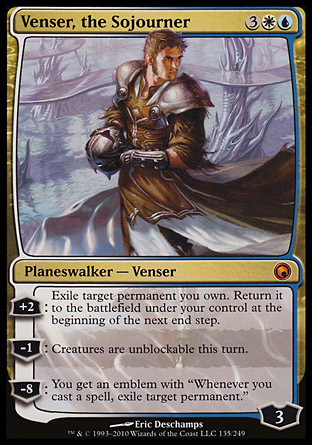
Traditional control decks will always have a home in standard. Even if the format doesn’t support control in the slightest, the players will make every effort to play the most skill intensive decks they can fathom. UW Control has been a dominant figure in Standard for a long time, but has very much been the tap-out control deck whenever possible. The return of Oblivion Ring brings the removal suite of UW Control back up in power, and though lacking a spot removal spell on par with Path to Exile, it is still capable of tackling a metagame focused on creatures. As UW Control has always been fond of utilizing Jace Beleren as a draw engine with Sun Titan, the loss of Jace, the Mind Sculptor has had a greater impact in choosing the central engine of the deck. In this case Venser, the Sojourner has been granted the opportunity to show off his skills, gaining advantage by flickering a variety of powerful cards, from Spreading Seas and Oblivion Ring to Solemn Simulacrum and Sunblast Angel. Though not an instant win as with the Mind Sculptor, Venser’s ultimate is very much worth working towards, and will frequently be underestimated by opponents before their lands whittle away as you cast simple utility spells such as Preordain. Though various builds of UW Control have seen moderate success since M12, it could prove to be a struggle for the deck to compete against the pace of Caw-Blade. There have already been signs of Brian Kibler’s famous Caw-go strategy being successful, so perhaps there is yet hope for UW Control lists aiming for the late game. Time will tell.

In the Middle of Difficulty lies Opportunity

It is impossible to deny the impact that Caw-Blade’s return has had on the metagame. Though not quite the monster it once was, Caw-Blade will be a dominant force across the globe simply due to familiarity. Having played with variants of the deck for months, players are very unlikely to take risks with less familiar strategies when they can stick with a deck that they know. As a result, Caw-Blade has successfully resumed its position as the enemy of the format, seizing the crown from Valakut, which couldn’t even maintain the title when the opportunity arose.

Hating out Caw-Blade whilst not leaving yourself open to the likes of Valakut, Red Deck Wins and Splinter Twin will be a difficult task this Nationals, and it does naturally lead any player familiar with Caw-Blade to wonder why they should bother fighting it. As players become increasingly worried about their mirror matches, the format will open in a way that was prevented by the reliability of Stoneforge Mystic and Jace, the Mind Sculptor. Caw-Blade is far from unbeatable, and when they focus on tearing one another apart then there is a chance to strike.

Next time...
I will be spending the next week working on a personal approach to the format, with a small variety of lists being tested against the primary threats expected at Nationals. My weapon of choice? A weapon that is often underestimated, and despite minor success has been ignored by the majority due to the difficulty involved in its use. Hopefully I will be able to tap some of the untapped potential, and prepare to go rogue at Nationals. Tune in next time for Project T!

Friday, 22 July 2011

The Road to Nationals - The Fringe

Following my last article looking at the state of the metagame following M12, I intend to use this article to focus on the decks gaining slightly less attention right now, but with strong potential to break into the top tier. With the right player and a perfected build, these decks provide the perfect opportunity to break through an unprepared metagame that is unprepared for the strategy. So let’s take a look!

The Fringe Decks
//Pyromancer Ascension
4Scalding Tarn
4Halimar Depths
8Island
8Mountain
4Pyromancer Ascension
4Gitaxian Probe
4Ponder
4Preordain
4Lightning Bolt
4Burst Lightning
4Into the Roil
4Mana Leak
2Tezzeret's Gambit
2Call to Mind

Another summer, and Pyromancer Ascension jumps back into the spotlight. Despite lacking Time Warp for an overpowering end game, Pyro has been given an incredible push towards the top tier with the reprinting of Ponder. With a sickening access to three powerful one mana tools to dig with, the vital move of finding the Ascension early should be simple. With an early, active Ascension, Pyro plays out its combo with well timed burn spells and copies, backed by multiplying counterspells.


Combo decks all seem to gain during the core set overlap seasons in the summer, but whilst Valakut and Twin aggressively push their combo through early, Pyro has the advantage of playing the long game. Resolving an Ascension is usually easier than successfully landing a Primeval Titan or a Deceiver Exarch, and each and every other vital spell is cheap enough to drive through any defence. Much like with Twin, the ability to bring in alternate win conditions from the sideboard allows Pyro to play a true and traditional control game, working towards a Titan or similar whist the opponent is burning through resources in order to prevent an Ascension landing, let alone becoming active.


An increasingly popular strategy right now is the hybrid deck PyroTwin. Taking the speed of the Twin combo and supporting it with the inevitability of Pyro, many are placing their bets on this deck following in the footsteps of Dark Depths Turbo. For those of you who don’t remember, Gerry T successfully broke the extended format apart during the Spring of 2010 with his fusion of the Vampire Hexmage + Dark Depths combo and the Sword of the Meek + Thopter Foundry combo. I cannot see PyroTwin reaching the dominance of DDT simply due to the colours in use, as DDT relied heavily on its disruptive discard. No number of Gitaxian Probes will remove an answer from the opponents hand, but perhaps careful counterspell choices will allow Pyro to reach the top tier as a part of this powerful hybrid.

//Birthing Pod
4Copperline Gorge
4Raging Ravine
4Misty Rainforest
4Scalding Tarn
4Forest
3Island
2Mountain
4Birds of Paradise
3Fauna Shaman
4Lotus Cobra
3Deceiver Exarch
1Sylvok Replica
1Tuktuk the Explorer
1Obstinate Baloth
1Phyrexian Metamorph
1Solemn Simulacrum
1Vengevine
3Acidic Slime
1Frost Titan
1Inferno Titan
3Birthing Pod
3Splinter Twin
4Preordain

Birthing Pod is a challenge that has been tackled by deckbuilders with increasing intensity since its release in New Phyrexia. At Pro Tour Nagoya we first caught a glimpse of the potential of the Pod, but with the diverse variety of bullets to build into in Standard we are bound to see a wide range of different decks built with the artifact in mind. While initial lists seemed to follow a straight-forward pattern of creatures ramping up to various Titans and Praetors at the top of the curve, but with the dominance of combo in Standard the tutoring ability of Birthing Pod enables the Splinter Twin combo to be included without affecting the smooth curve of the midrange deck.


The sheer flexibility of Birthing Pod decks is obviously reminiscent of Fauna Shaman’s impact in Naya and Bant decks prior to the last rotation, with singleton bullets now easier than ever to dig into. During the current PTQ season it is perfectly plausible to metagame carefully and maindeck a variety of powerful hate cards. Alas, for Nationals it is far harder to metagame, particularly in the UK due to the lack of good communication between gaming communities. Should the top decks reach a state of relative stability, a reliable but personalized list with proven bullets in the sideboard could succeed against the very narrow decks currently dominant.

//Architect
4Inkmoth Nexus
3Buried Ruin
16Island
4Grand Architect
4Thrummingbird
3Spellskite
3Treasure Mage
2Solemn Simulacrum
2Wurmcoil Engine
1Triskelion
3Contagion Clasp
1Contagion Engine
2Mindslaver
4Everflowing Chalice
3Tumble Magnet
3Preordain
2Tezzeret's Gambit

Architect has been hyped since its release, and despite multiple attempts to break the card it took a long time for it to find its home in this deck. Unfortunately, the deck was easily forgotten as Caw-Blade seized control of the format. There are many powerful interactions in the deck, but the simple ability to ramp into game winning power artifacts like Mindslaver makes the strategy worth considering once more. A variety of tools are worth considering in modern builds, especially potential effective use of Tezzeret, Agent of Bolas. It is M12 though has given us a true gem to work with in Buried Ruin. Replicating Academy Ruins in a less overpowering manner, Buried Ruin allows deadly recycling of the the powerful win conditions, and allows utter control with Mindslaver to dominate the opponents turns for far longer than is necessary to win. Solemn Simulacrum is also a powerful new (old) tool for this kind of deck, working perfectly to keep the tempo in building into the late game.


The weakness of mono-coloured control decks in recent times has been sideboarding, as the colour pie has made splashing for a second colour a necessity to survive. However, Scars of Mirrodin block has brought a powerful array of artifacts to effectively replicate the effects of the solutions once splashed for. Ratchet Bomb provides a powerful sweeper right now, with Tempered Steel and Red Deck Wins being priced low and in large numbers. Batterskull changes the game quite dramatically in providing a non-white deck with access to a powerful Baneslayer Angel effect against aggro, with the insane ability to act as a near unstoppable win condition against control. At the cost of Trinket Mage it is easily conceivable that Torpor Orb will fill out a chunk of the sideboard to ease the combo match-ups whilst Flashfreeze fill the final slots in being the most useful answer to the largest range of threats.

//Eldrazi
1Eye of Ugin
4Eldrazi Temple
2Khalni Garden
4Tectonic Edge
14Forest
2Emrakul, the Aeons Torn
1Kozilek, Butcher of Truth
2Ulamog, the Infinite Gyre
3Wurmcoil Engine
2Terastodon
4Overgrown Battlement
4Everflowing Chalice
4Rampant Growth
3Explore
4Summoning Trap
4Quicksilver Amulet
2Ancient Stirrings

The initial form of the Eldrazi deck ran very similarly to Valakut by abusing Primeval Titan to dig for the vital land, in this case Eldrazi Temple and Eye of Ugin. It feels strange to see a list without Primeval Titan, but Japanese Nationals brought the Eldrazi back into play utilizing the new tool Quicksilver Amulet. This wonderful piece of artifice allows you to drop an Eldrazi at the end of the opponent’s turn, before swinging in for the win with Annihilator making short work of the board. Green unsurprisingly allows for solid acceleration into both the Amulet and a variety of costly monstrosities, with a total of 15 options for acceleration on turn 2. Wurmcoil Engine and Overgrown Battlement provides a solid wall to defend against aggro, whilst Summoning Trap proves to be a potent threat against the current widespread use of Mana Leak.


Eldrazi appear to be well positioned to use raw power against decks that can have their tempo disrupted harshly when forced to change their role in the game. Though Primeval Titan didn’t make a showing in the limelight stealing list from Japan Nationals, it is important to be equally prepared for the Titan as well as the Amulet. Green provides a solid array of sideboard options as has been noted with Valakut, but the intensity of green mana makes Garruk, Primal Hunter a tempting tool to put to use. This seems to be an idea worth testing, as our new Garruk is undoubtedly a powerful weapon seeking a home, and every green deck can do with extra draw.


Anything Missing?
So, &?

It should be pretty clear that a certain colour combination has been missing throughout my most recent articles. Fear not, it has not been ignored, as I will be covering my favourite colour combination in my next article. Stay tuned!

Friday, 15 July 2011

The Road to Nationals - The Top Tier

In this article I intend to discuss my predicted top tier decks for the Standard format with M12 legal as of today. I have provided rough lists for each deck, based on results prior to M12 as well as expected inclusions. I will continue to investigate the format over the next week as I move on to investigate the current fringe decks threatening to break into the top tier. So let’s get started!

The Top Tier

4Valakut, the Molten Pinnacle
3Terramorphic Expanse
3Evolving Wilds
6Forest
12Mountain
4Primeval Titan
4Overgrown Battlement
4Solemn Simulacrum
2Urabrask the Hidden
1Oracle of Mul Daya
1Avenger of Zendikar
4Explore
4Rampant Growth
3Green Sun's Zenith
2Lightning Bolt
2Dismember
1Harrow

At Pro Tour Paris earlier this year, Valakut was destined to dominate. Or so it seemed, until Sword of Feast and Famine proved to be too much for the Molten Pinnacle to handle. Though Valakut has seen a fair amount of success during the reign of Caw-Blade, it now has the opportunity to jump back into the spotlight. Four key cards have been released since Valakut was last truly considered to be a competitor. New Phyrexia brought us the alternative to Summoning Trap in Green Sun’s Zenith, acting as a far more reliable Primeval Titan 5-8 as necessary, whilst Urabrask the Hidden allows swift one turn kills with Primeval Titan. With these additions boosting the deck’s ability to kill, M12 has brought tools to improve reliability in the form of Rampant Growth and Solemn Simulacrum.

Valakut is undoubtedly at its prime right now, and has a solid assortment of sideboard options available to it. Pyroclasm and Slagstorm are very powerful sweepers at the moment in Standard, with Act of Aggression and Combust providing solid outs to specific threats such as Splinter Twin. As for creatures, green provides a wonderful selection of useful beasts to work with. Thrun is a powerful option with control currently depending heavily on their spot removal, and similarly Gaea’s Revenge is proving to be an efficient win condition now that Sword of Feast and Famine and Baneslayer Angel are a rare sight. Obstinate Baloth rounds up the sideboard options, and will likely be a necessity with the inevitable rise of red aggro this format.

Scalding Tarn
2Misty Rainforest
7Island
7Mountain
4Tectonic Edge
4Deceiver Exarch
3Spellskite
1Wurmcoil Engine
1Treasure Mage
4Splinter Twin
1Mindslaver
4Preordain
4Ponder
3Gitaxian Probe
3Into the Roil
4Mana Leak
2Dispel
2Mental Misstep

The Deceiver Exarch + Splinter Twin combo is so powerful in Standard that it made a strong impact on the format during the reign of Caw-Blade, and even spawned a hybrid deck with Caw-Blade itself in its final weeks. Starting with that in mind, it isn’t difficult to see Splinter Twin as the benchmark by which all Standard decks for the remainder of the season will be judged. With the reprint of Ponder, Splinter Twin gains even greater reliability, threatening Valakut for the position of best combo, if not best deck, in the format!

Splinter Twin amazingly has main deck space to work with when planning for specific metagames. In the build above, I opted to include the flexible and powerful Treasure Mage package introduced by Patrick Chapin at Pro Tour Paris, only to be forgotten in the Stoneforge driven era. Mindslaver is a brutal win condition against combo right now, particularly with the widespread use of Spellskite. Wurmcoil Engine gives the deck the time it desperately needs against aggro, whilst providing a backup beatstick to threaten opponents who are dead set on stopping the your combo.

In terms of a sideboard, the generic options available are very solid in both blue and red. Combust answers opposing Exarchs, Pyroclasm slaughters aggro, Spreading Seas can be used to back up the Tectonic Edges and there’s always Dismember for everything, obviously. The sideboard is very open to tinker with, allowing for added win conditions such as Titans, or even complete transformations into control or unexpected combo’s such as Shape Anew. Transformation into a wildly different combo proved relatively successful for Pyromancer’s Ascension decks last summer when they sided into Polymorph, and with no Mind Sculptor the idea of Shape Anew into Blightsteel Colossus is quite tempting. The card that will definitely see an increased presence in sideboards, and possibly even main decked, is Mental Misstep. Discard and red present plenty of one cost spells that you would definitely want to counter, and so just like Spell Snare before it I certainly expect Mental Misstep to see play this summer, and Splinter Twin looks to be the best home for it (at least intially).

4Creeping Tar Pit
4Darkslick Shores
4Drowned Catacomb
4Tectonic Edge
5Island
5Swamp
1Consecrated Sphinx
1Grave Titan
1Wurmcoil Engine
3Jace Beleren
1Liliana Vess
4Mana Leak
4Preordain
3Inquisition of Kozilek
1Duress
1Despise
3Go for the Throat
2Dismember
2Into the Roil
4Spreading Seas
1Stoic Rebuttal
1Black Sun's Zenith
1Jace's Ingenuity

After total domination at Worlds last year, UB Control vanished completely at the dawn of Caw-Blade. At GP Singapore the control legend Shouta Yasooka successfully top 8’d with a control list utilizing Torpor Orb to beat Stoneforge Mystic, but the shell of the deck was very traditional. As soon as the bans came into force, UB Control leapt to the top of the Magic Online Daily events, proving the popularity of blue based control above anything else. With a selection of the most powerful win conditions to work with, UB is capable of reliably disrupting combo and controlling the board with efficient removal.

With M12, UB Control faces the threat of increased reliability from combo and pace from red. Without the flexibility of white’s red hate, UB will have to carefully tailor its anti-aggro package. Flashfreeze is an obvious inclusion, hitting almost every key spell in the format. Batterskull and Disfigure present some of the most effective answers to aggro, but the inclusion of alternative kill such as Doom Blade may become increasingly relevant with the rise of Tempered Steel decks. Further discard with Duress backed by Surgical Extraction could prove to be an effective package in combating the inevitable mirror, but diversity in win conditions between the main and side is definitely necessary. Calcite Snapper and Vampire Nighthawk have both seen varied success in the past out of UB Control sideboards, both in holding off aggro and tactically providing the opportunity to transform into a more tempo-oriented deck. Unsurprisingly, control will have to handle several main deck slots and the majority of the sideboard based on the evolution of the format. Either way, expect Flashfreeze and Mental Misstep to become a regular sight.

4Blackcleave Cliffs
4Dragonskull Summit
4Lavaclaw Reaches
4Marsh Flats
7Swamp
4Bloodghast
4Gatekeeper of Malakir
4Kalastria Highborn
4Pulse Tracker
4Vampire Lacerator
3Viscera Seer
4Dismember
3Go for the Throat
4Lightning Bolt
3Staggershock

Even prior to the July 1st Ban List update, Vampires were making a name for themselves. Even the mighty Caw-Blade struggled to stand up to the raw aggression of Vampires, with the deck claiming the win at both the Denver and Indianapolis SCG Opens in June. With a powerful set of removal spells and burn to supplement the weenie rush, Vampires utilize Bloodghast and Highborn to continue to build momentum in the face of removal. Though little is gained by the deck in M12, the fall of Caw-Blade has resulted in a sharp drop in the presence of Sword of Feast and Famine, making Vampires a better choice than ever.

Though it has to compete with many other fast decks right now, black provides Vampires with a couple of major advantages in sideboarding. Discard spells like Duress allow Vampires to handle combo and control, and a wide variety of spot removal spells for aggro of all flavours. Act of Aggression and Dark Tutelage are solid options to maintain control of the game as it progresses, and the ability to drop an early Demon of Death’s Gate could yet again allow the deck to race combo decks like Valakut whilst they sit back playing solitaire.

4Arid Mesa
4Scalding Tarn
4Teetering Peaks
10Mountain
4Goblin Guide
4Grim Lavamancer
4Furnace Scamp
4Stormblood Berserker
4Lightning Bolt
4Burst Lightning
4Incinerate
4Searing Blaze
2Staggershock
4Shrine of Burning Rage

With M12 it should come as no surprise that Red is firmly back in the top tier. Following the surge of powerful burn spells in Zendikar, the addition of Shrine and Lavamancer helps the deck get there by providing an inevitability. This rough list follows a more traditional RDW route, but be prepared for a wide variety of powerful threats from players tapping Mountains. Koth is still an incredibly powerful Planeswalker (arguably the most powerful since the departure of Jace, the Mind Sculptor) but really requires 23-25 lands to be played, eating into some of the space occupied by burn at present. Chandra’s Phoenix is another powerful beast that would likely be best suited to a more reliable mana base, resulting in a list similar to Katsuhiro Mori’s winning list at Japan Nationals last year.

Red also has a wealth of powerful sideboard cards at the moment. Dismember is a vital tool for answering previously unanswerable threats such as Kor Firewalker. Combust is the perfect answer for Deceiver Exarch in that it cannot be redirected by Spellskite, and Act of Aggression adds a new dimension to the traditional use of Threaten in being able to seize control at instant speed, preventing Primeval Titan wins and more. In hating control decks, red has access to Manic Vandal to disrupt the various Spellskites and Batterskulls, whilst Manabarbs thrives in a format lacking in answers to enchantments aside from Oblivion Ring.

4Glacial Fortress
4Inkmoth Nexus
6Plains
4Seachrome Coast
4Memnite
4Signal Pest
4Spellskite
4Steel Overseer
4Vault Skirge
4Dispatch
4Glint Hawk Idol
3Mox Opal
4Origin Spellbomb
3Preordain
4Tempered Steel

Following Pro Tour Nagoya it should come as no real surprise that Tempered Steel aggro would make its way over to Standard at some stage, but the sheer popularity of the deck recently on Magic Online certainly does surprise! The last time a deck made such a dramatic transfer was during the Lorwyn Block PTQ season when Kithkin first started to use Windbrisk Heights to hideaway everything from Thistledown Liege to Mirrorweave. Following dramatic success in Block, Standard saw a sudden surge in popularity for the deck, eventually resulting in the major success of such decks as BW Tokens.

Tempered Steel plays very much like an Affinity deck, being able to drop very cheap creatures that result in a critical mass of damage a couple of turns down the line. Interestingly, Inkmoth Nexus presents a truly terrifying alternate dimension to the deck, in that it can threaten to kill even if you manage to bring your life total under control. It is worth noting here that the ability to include Spellskites in the main prevents the deck from falling victim to combo when they fail to interact. Add to that the fact that Dispatch, in this deck, is scarily superior to Swords to Plowshares, and we have a fearsome deck to be reckoned with.

As with any deck in Standard, Dismember is always a solid sideboard option for any threats to be feared, but white also provides plenty of solution cards such as Celestial Purge and Revoke Existence. Phyrexian Revoker and Hex Parasite provide strong tools to wield against the still Planeswalker dependent control decks, and Etched Champion serves to imitate Paladin en-Vec.

To Be Continued...

I'll follow up shortly with the decks competing to enter the top tier. Any suggestions or recommendations for the article are welcome, and feedback will be much appreciated!